Rare bargain hunting! Since August, the net inflow of A-share ETF funds has been approximately 112.786 billion yuan.
Recently, the A-share market has fluctuated widely. Since August, the Shanghai Composite Index has continued to decline, falling below 3,100 points. However, bargain-hunting funds have been particularly active, with more than 110 billion yuan of funds pouring into the market through A-share ETFs.
Looking over a longer period of time, since mid-April, the net inflow of ETF funds has exceeded 340 billion yuan. "Buy small when it's small, buy big when it's big", bargain-hunting funds achieve the goal of "others are fearful, I'm greedy".
More than 100 billion in funds to buy bottoms
From August 1 to August 25, the Shanghai Composite Index fell by more than 200 points from 3290 points to 3064 points. However, Wind data shows that since August, the net inflow of A-share ETF funds has been approximately 112.786 billion yuan, with an inflow of over 100 billion yuan in less than a month, which is really rare.
Among them, broad-based index ETFs such as CSI 300, Science and Technology 50, and Shanghai Stock Exchange 50 have become the main gold-attracting targets. Since August, Huatai-Berry CSI 300 ETF has had a net inflow of 28.55 billion yuan, ChinaAMC SSE Science and Technology Innovation Board 50-component ETF has a net inflow of 15.865 billion yuan, and ChinaAMC SSE 50 ETF has a net inflow of 15.865 billion yuan. The inflow was 9.469 billion yuan, and the net inflows of China Southern CSI 500 ETF, ChinaAMC CSI 300 ETF, Harvest CSI 300 ETF, and E Fund CSI 300 ETF all exceeded 5 billion yuan.
Net inflows of some broad-based index ETFs
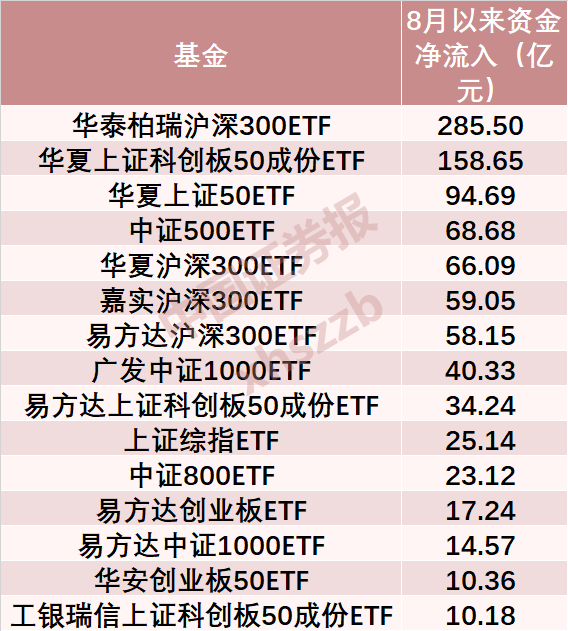
Data source: Wind
Looking at industry themes, medical, semiconductor, military and other industries are favored by bargain hunting funds. Since August, China Securities Semiconductor Chip ETF and Guolian Securities All-Inclusive Semiconductor Products and Equipment ETF have net inflows of 1.898 billion yuan and 1.791 billion yuan respectively; Huabao CSI Medical ETF and E Fund CSI 300 Medical and Health ETF F. The GF CSI Medical and Health ETF had a net inflow of 3.594 billion yuan, 1.689 billion yuan, and 956 million yuan respectively; the Cathay CSI Military Industry ETF and GF CSI Military Industry ETF had a net inflow of 1.330 billion yuan and 753 million yuan respectively.
Narrow-based ETFs with the largest net capital inflow
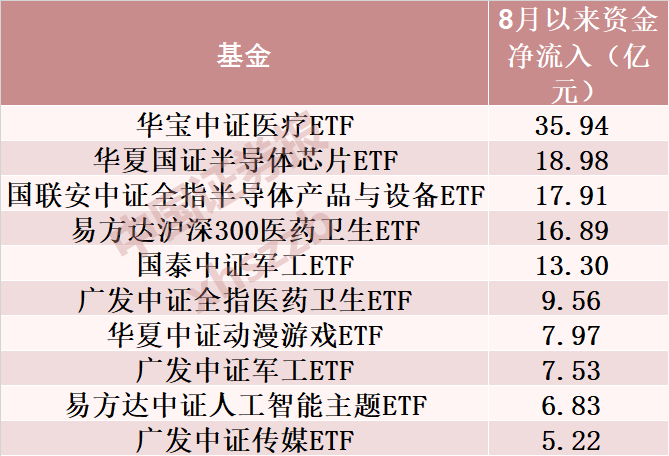
Data source: Wind
Extending the time shows the "surging" of bargain hunting funds. Since mid-April, when the Shanghai Composite Index fell from 3,400 points to 3,064 points, approximately 340.9 billion yuan of funds poured into A-share ETFs. Among them, only two giant funds, Huatai-Berry CSI 300 ETF and ChinaAMC SSE Science and Technology Innovation Board 50 Component ETF, have a combined net inflow of more than 100 billion yuan.
兼具配置和交易需求
今年以来,对宽基指数ETF的“抄底”一直是热门话题。 Behind the continued influx of funds is strong allocation and transaction demand. "At this stage, the market is expected to have rebound opportunities, and many investors will tend to seek overall market returns through the deployment of passive funds, especially broad-based ETFs." said a quantitative fund manager of a fund company in East China.
He believes that since the beginning of this year, the market has been volatile and sector rotation has intensified. It has become more difficult to capture excess returns through active investment at the right time. At the same time, as the number of stocks increases, the difficulty of stock selection has also increased, and the challenges faced have also become greater. In comparison, the valuation of the current mainstream broad-based index in the market is already at a low level, and it has the value of both short-term trading and medium- and long-term allocation.
China Asset Management said that from a different perspective, index funds have become the preferred tool for asset allocation for more and more investors. In 2022, the scale of ETFs in many sub-sectors will increase significantly. The scale of Hong Kong stock ETFs will increase by 62 billion yuan, and the scales of pharmaceutical, chip, and carbon neutral related ETFs will increase by 15.69 billion yuan, 12.1 billion yuan, and 8.12 billion yuan respectively. Especially when the index falls, the phenomenon of buying more is obvious as it falls.
The above-mentioned quantitative fund managers believe that industry theme ETFs have the characteristics of clear investment areas, high investment transparency, and stable styles. When the industry sector has obvious investment value, it is a powerful tool for investors to seize industry development opportunities. At the same time, ETF investment direction is clear, positions are high and stable, and transactions are fast and convenient. It is expected to become the choice of more and more investors.